On the last day of May, in the Süwag Energie Arena in Frankfurt, Fan Zhendong played the final match of his only season for 1. FC Saarbrücken. It was the final of the first Final4 in the history of the Tischtennis Bundesliga, against Borussia Düsseldorf. Fan, the Olympic champion in Paris two summers earlier, had already beaten Dang Qiu; now Kanak Jha took the first game 11-6 and the fourth 11-9, and Fan took the decider 11-6. Saarbrücken won 3-1. They had won the German Cup in January and the Champions League a fortnight earlier, so the title completed the first treble in the club's history. "I am very happy that I could help the team with two victories," Fan said afterwards, which is about as much as he ever gives away.
The team he had just beaten were his next employers. In March Düsseldorf had announced that Fan would join them on a one-year contract for 2026-27, and he arrived on 1 July. He has not played on the World Table Tennis (WTT) circuit since stepping away from international competition at the end of 2024, which is why his name is missing from the world rankings. He did not need to come to Europe at all. Two years running he has chosen the German league anyway, and his explanation was a sentence any club manager in the country would happily frame: "Borussia Düsseldorf is one of the strongest forces in European and world table tennis."
That is the question this piece sets out to answer. China has the best players, Japan has a younger and glossier league, India has a franchise competition on national television, and the WTT calendar leaves a top player with fewer free weekends each year. Yet the German league, played in sports halls that seat a few thousand at most, remains the place the sport's best players go when they want a club. Eleven matched every registered squad in the six main domestic professional leagues, and in the Champions League, against the men's world top 100, and Germany comes out ahead on both counts that matter: more of the top 100 than anywhere else, from more countries than anywhere else.
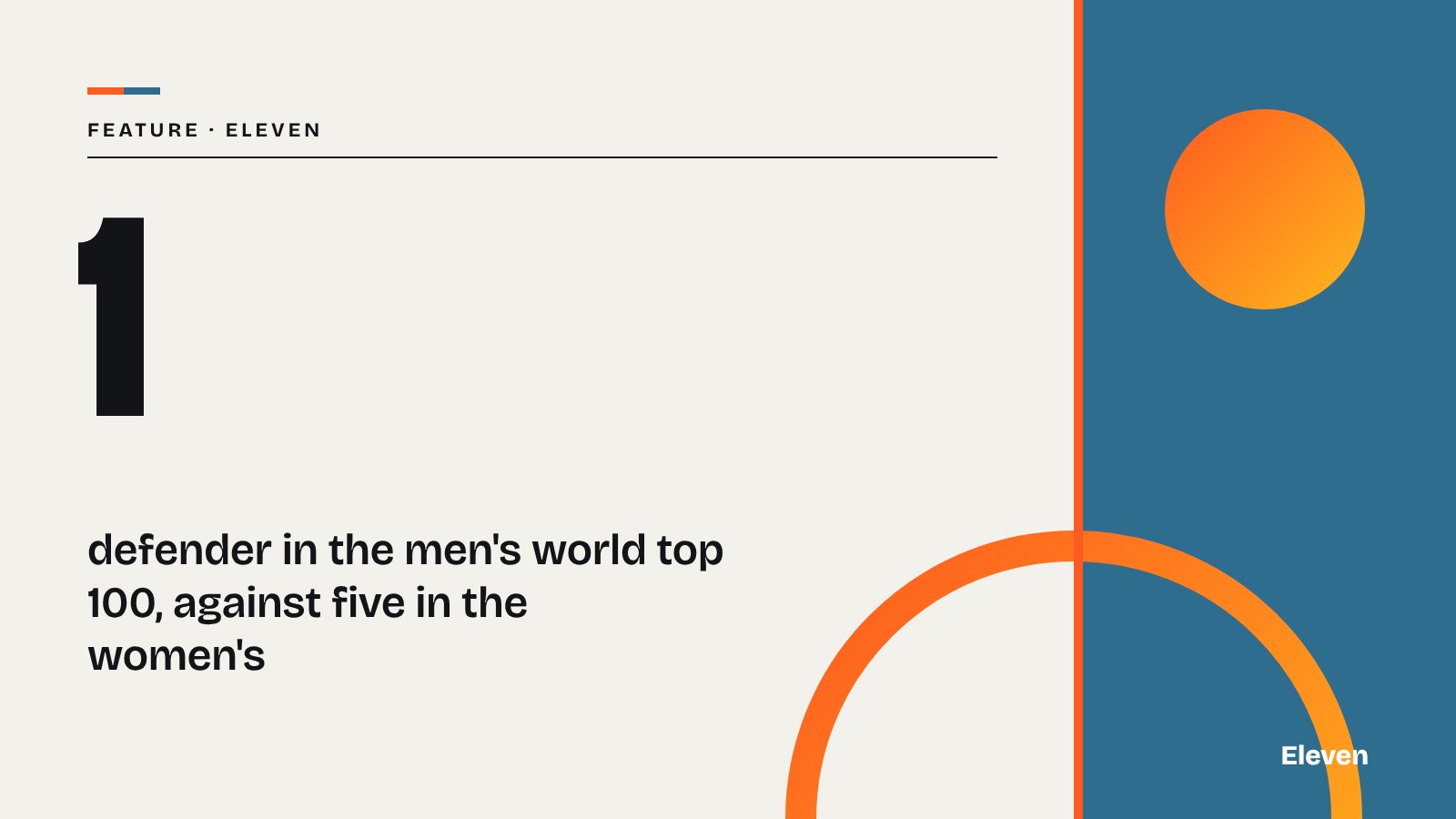
The numbers are clear enough. Of the top 100 in the ITTF men's ranking published on 9 November, 29 are registered with one of the Bundesliga's 12 clubs. France's Pro A, the nearest rival, has 19, and Japan's T.League has 18. China's Super League has 10, which is every Chinese player in the top 100 and nobody else. India's Ultimate Table Tennis also has 10, and Major League Table Tennis in the United States has four. Players can appear in more than one league, and several do: the Chinese players Zhou Qihao and Wen Ruibo are also registered with GV Hennebont in France.
- Germany: Bundesliga29
- France: Pro A19
- Japan: T.League18
- China: Super League10
- India: Ultimate Table Tennis10
- US: Major League Table Tennis4
Eleven matched every player in the registered 2026-27 squads (2026 for China and India) of seven professional leagues against the top 100 of the ITTF men's world ranking for week 46, published on 9 November 2026. A player registered in two leagues counts in both; 13 of the top 100 are registered in none.
Source: TTBL; FFTT; T.League; NetEase; UTT; MLTT; ITTF world ranking
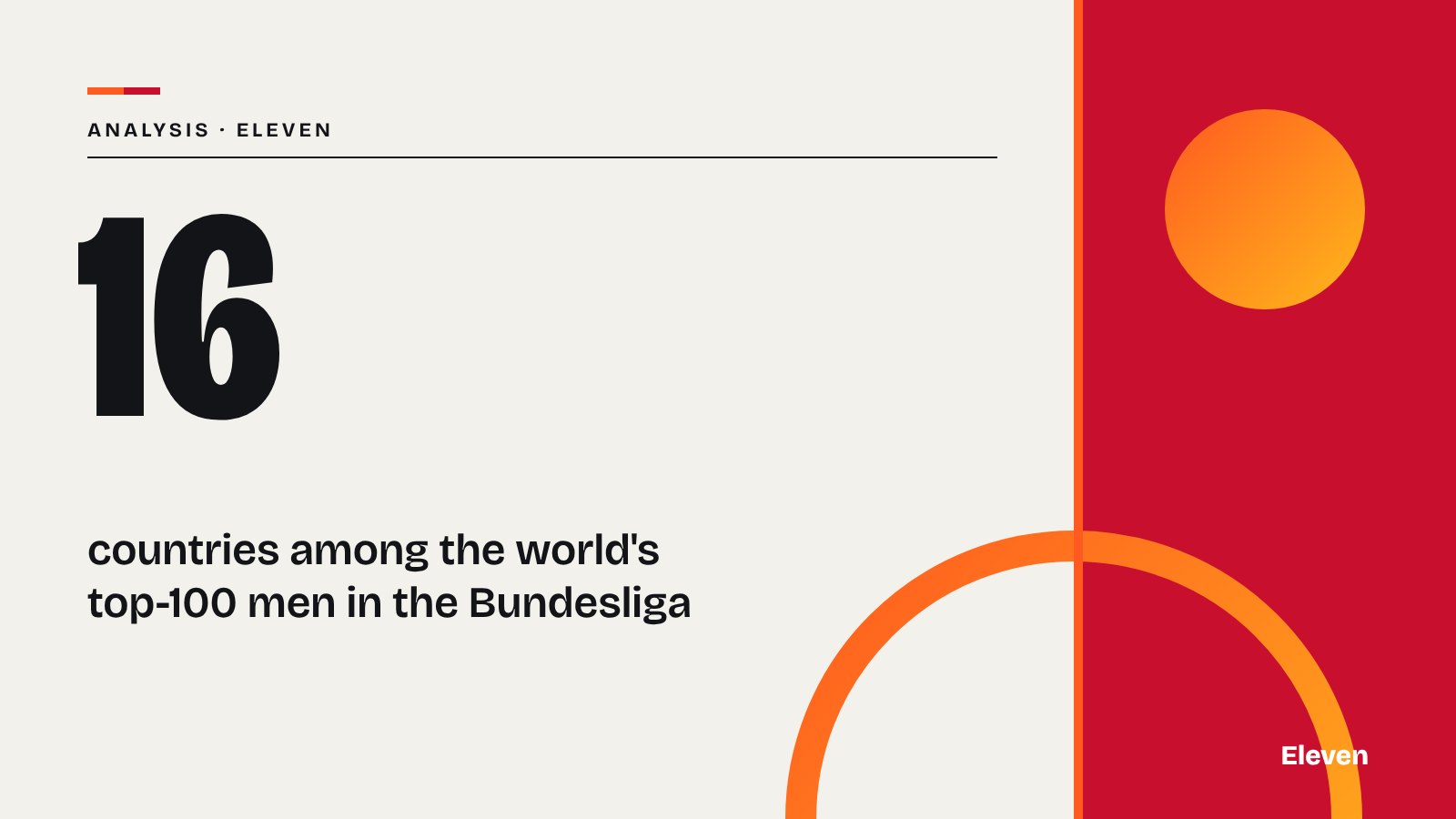
Breadth is where the gap becomes a chasm. Those 29 Bundesliga players come from 16 countries, from Brazil's Hugo Calderano at Saarbrücken to Kazakhstan's Kirill Gerassimenko at Werder Bremen and Australia's Finn Luu at Bad Homburg. Pro A's 19 come from eight. The T.League's 18 come from three, Japan, South Korea and Taiwan. The Super League's 10 come from one, and in 2026 every one of its 61 registered men was Chinese. All six German men in the top 100 play at home, which leaves 23 foreigners from the top 100 in a single 12-club league. No other league in the sport looks so much like the world ranking.
- Germany: Bundesliga16
- France: Pro A8
- India: Ultimate Table Tennis6
- US: Major League Table Tennis4
- Japan: T.League3
- China: Super League1
Eleven counted the nationality given in the ITTF ranking for each top-100 player in each league's registered squads. The Bundesliga's 29 come from 16 countries, among them all six German men in the top 100.
Source: TTBL; ITTF world ranking
None of this was designed. It accreted over 60 years, and it started with a federation that is older than the ITTF itself. The Deutscher Tischtennis-Bund (DTTB) was founded in Berlin on 8 November 1925, a year before the international federation and the first World Championships in London, and was one of the ITTF's founding members in 1926. For four decades the national team title was settled in a one-off final. Then, at its annual assembly on the North Sea island of Borkum in July 1965, the DTTB voted to create a national league. The first Bundesliga season began on 10 and 11 September 1966 with eight clubs, and a Düsseldorf club, TuSA, were its first champions.
The club that defined it arrived two years later. Borussia Düsseldorf were promoted in 1968 and won their first Bundesliga title in 1969, the year their best player, Eberhard Schöler, reached the men's singles final at the World Championships in Munich and lost it to Japan's Shigeo Itoh in five games. Schöler is still the only German man to have played in a world singles final. Borussia also did something that sounds mundane and was in fact the template for everything since: according to the club's history it was the first German table tennis club to employ a manager and a coach. Hans Wilhelm Gäb, another Borussia player of that era, was described by the federation's president, Konrad Grillmeyer, at its centenary last year as "a stroke of luck for German table tennis; without his vision and dedication, our sport in Germany would look very different today."
Borussia have been champions 33 times in the Bundesliga's 60 completed seasons, a dominance with few parallels in any European league. 1. FC Saarbrücken are the outsiders who finally broke it: a first title in 2020, four Champions League titles running from 2022-23 to 2025-26, and last season's treble.
The foreign players came with the sponsors. Through the 1970s and 1980s companies began paying for stars from abroad, and the names from that era read like a world championship draw: Dragutin Šurbek from Yugoslavia, England's Desmond Douglas, Andrzej Grubba from Poland, Sweden's Mikael Appelgren and, later, Jan-Ove Waldner. The league tried at intervals to slow it down. From 1982-83 a club could field only one foreigner, a rule later dropped. From 1993-94 a six-player squad could include two, at least one of them from the European Community. Neither stopped the flow.
The 1990s turned the Bundesliga from a good league into the place a career was built. Vladimir Samsonov, the Belarusian who would spend much of the decade near the top of the world ranking, signed for Düsseldorf in 1994 and stayed six years, winning European club titles in 1997, 1998 and 2000. The European competition itself changed shape in that time. The European Club Cup of Champions, first won by CSM Cluj of Romania in 1960-61, was replaced in 1998-99 by the Champions League, and Düsseldorf now hold 12 European titles across the two, more than any other men's club. A Bundesliga contract had become a ticket to the continent's biggest club stage as well.
The league's capacity to absorb ageing greats is its oddest and most revealing quality. Waldner, the Swede many still call the greatest player of all, played for TTC RhönSprudel Fulda-Maberzell from the 2005-06 season until May 2012, by which point he was 46. His compatriot Jörgen Persson, another former world champion, joined Fulda in 2007. A league that keeps former world champions in work into their forties is not a showcase in the way the WTT circuit is. It is a working environment, a place to train, compete every other weekend and be paid for it.
No one embodied that better than Timo Boll. He joined Düsseldorf on 1 July 2007 and played for them for 18 years, until his retirement in 2025, and won the Champions League with them several times. He also played spells in the Chinese Super League, so he knew the alternative. When Fan's move to Düsseldorf was announced, Boll, now the club's ambassador, explained it in terms the club's founders would have understood: "His move to Düsseldorf is a logical step, this is where the heart of table tennis beats." Fan named Boll as a reason for the move, saying that "my close relationship with Timo Boll has further inspired me to take on a new challenge."
So why Germany rather than China, where the money is widely assumed to be bigger and the opposition is certainly stronger? The answer is mostly in the calendar and the rules. China's Super League was reformed for 2026: its regular season was played in two blocks in July and August, in Dalian and Xiong'an, and its finals run in Guangzhou from 25 to 27 December. That suits Chinese national-team players, who play for provinces and sponsors around the team's own schedule. It offers foreigners very little. Truls Möregård was the only foreign player listed in the league in 2023, and in 2026 there were no foreign men at all.
Japan's T.League, which began in 2018, is the more interesting comparison, because it was built from scratch to do what the Bundesliga does. It has six men's clubs, a season from July to March and its own quick-fire rules, with the last game of each match starting at 6-6. It also has two of the top three players in the world, Sora Matsushima and Tomokazu Harimoto, both at Okayama Rivets. What it does not have is a reason for a Swede, a Portuguese or a Dane to move there. Its pull is regional, and on Eleven's count it draws only from Japan and its nearest neighbours.
- Germany (2 clubs)9
- France7
- Poland4
- Czech Republic1
Eleven matched the 24 squads registered with the European Table Tennis Union for the 2026-27 men's Champions League against the men's world top 100 for week 46. Saarbrücken have six of the 21 and Düsseldorf three.
The Bundesliga, by contrast, runs from August to May on weekends that fit around WTT events, which matters when the WTT calendar already fills most of a top player's year, as Eleven's count of the WTT workload showed. A team match is four singles and a doubles, first to three, and it is over in an evening. It also feeds the Champions League, where Eleven's count shows the same pattern from the other side. Of the 21 men from the top 100 registered for this season's competition, nine play for one of only two German clubs in it, Saarbrücken and Düsseldorf. French clubs have seven, Polish clubs four and a Czech club one.
Saarbrücken's squad shows how flexible that system has become. Möregård, the Swede who is sixth in the world, is registered with Saarbrücken for the Champions League but not for the Bundesliga. Calderano, seventh, plays in both. Patrick Franziska, the captain, is the German constant around whom the club rebuilds each summer. The German Cup, the Bundesliga and Europe give a club three competitions in which to use them, and a player three chances a season to win something.
The money, unusually for a sport so keen on prize funds, is the part nobody discloses. Clubs do not publish salaries or budgets, and Eleven could find no reliable figure for any of them. What is public is the way the league pays for itself. Since November 2010 it has been run by its own company, TTBL Sport GmbH, owned by an association of the first-division clubs, and it took the name TTBL from 2011-12. Liebherr, the crane and machinery maker which also gives its name to TTF Liebherr Ochsenhausen, sponsors its finals, and since August 2023 every match has been streamed on Dyn, a German subscription service, which shares 10% of its net subscription revenue among its five partner leagues. Dyn says that came to a seven-figure sum in 2025, split across table tennis, basketball, handball, hockey and volleyball.
Television, when the league reaches it, finds an audience. The 2023 final, shown on ARD as part of a multi-sport festival, reached up to 1.6 million viewers per live broadcast, according to the league. Crowds in the halls are smaller. Nico Stehle, the league's managing director, said in July that "In the Bundesliga alone, nearly 80,000 spectators watched the matches in the arenas", more than ever before. Spread across the 132 regular-season matches of a 12-team league, that is about 600 a match. The record was set with Fan in the league, and Stehle did not pretend otherwise: "Many people initially became aware of the league because of Fan."
Fan's arrival changed what a Bundesliga club can be. When Saarbrücken signed him in June 2025, their manager, Nicolas Barrois, told Sport1: "This is not the league's project, it's our project" (translated from German), adding that it was "a huge image boost for us". By October Franziska was telling the league's website that "almost 2,000 Chinese people from all over the world travel to see Fan Zhendong play", and that "Fan has really changed everything, every home game and every away game – but it's cool." Düsseldorf's manager, Andreas Preuss, set out the wider ambition at the club's presentation in August, saying "Fan opens doors for economic and cultural exchange" and "It's not just about more sponsorship revenue." Fan signed the city's Golden Book at the town hall, and the ceremony was broadcast live to China.
There is a fragility in all this that the record crowds can hide. A league of 600-a-match audiences that relies on a regional manufacturer, a streaming partner and one Chinese superstar on a one-year deal is a delicate thing, and the clubs know it. When Boll retired, Franziska was asked whether he could be the league's new face and said, "But ultimately, the fans decide that" (translated from German). The deeper strength is the one built at Borkum: clubs that are institutions rather than franchises, a season long enough to give players a working life, and a door that has been open to the world, with the odd hesitation, since the 1970s. When the 20-year-old Möregård left Sweden for Neu-Ulm in 2022, he told SVT simply: "It was too hard to not say yes to it" (translated from Swedish).
Düsseldorf are top of the table, unbeaten after seven matches, with Fan, Dang Qiu, Anton Källberg and Kanak Jha. The man who beat Kanak Jha 11-6 in a fifth game in Frankfurt now plays alongside him. "I want to embark on this next adventure and leave a legacy at this great club," Fan said at the town hall. Sixty years after Borkum, the greatest players in the world still come to Germany to do what Waldner did at 46 and Boll did for 18 years: play for a club, every other weekend, for a few hundred people who know exactly what they are watching.